Grid · pallets & cages
Faster, easier movement for heavy loads.
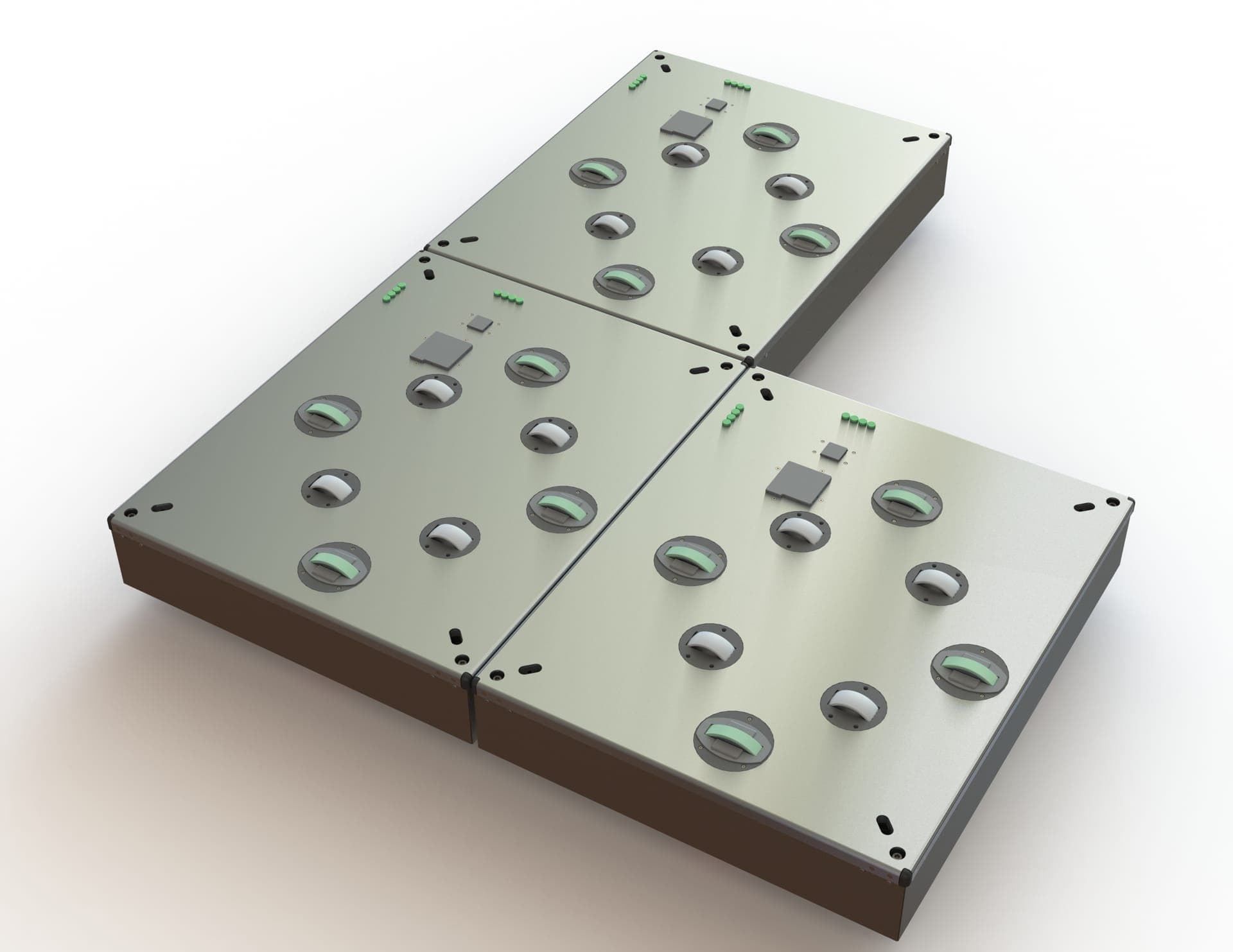
Grid is a tiled system for cage, dolly and pallet sortation, sequencing and presentation. It runs the same AI engine as Matrix: concurrent, real-time, with no advance planning. It's cost-effective hardware designed to make warehouse teams more productive.
50%
less space needed
~50%
less pick labour
400+
cases per hour per picker
Days
to install, not months
The clearest Grid application
Built for the grocery CDC.
Chilled, frozen and ambient distribution at scale, serving superstore and supermarket networks with high SKU variety, complex store networks and significant seasonal labour demand. Grid reduces the floor space needed by around 50% and cuts pick labour by a similar margin, and both improve a CDC's key metric: the cost of moving every case.
The sweet spot is CDCs serving mostly superstores and supermarkets, with fewer than around 100 stores, hit rates above 1.25 and predictable order profiles. If that describes your operation, Grid is almost certainly worth modelling.
- Documented performance of 400+ cases per hour per picker
- Handles chilled, frozen and ambient on the same hardware
- Reduces seasonal agency dependency at peak
The Grid tile
One tile. Every capability.
Drives itself
Each tile is an independent, self-propelled unit. No fixed conveyors. No tracks. The floor reconfigures around the operation — not the other way around.
Handles heavy loads
Designed specifically for cages, dollies and pallets. The same concurrent movement model as Matrix, on hardware built for unit loads that tote-based systems can't touch.
Installs in days
No groundworks. No structural changes. Grid installs into existing space and integrates over a standard API so most operations are up and running within days of hardware arrival.

More Grid applications
Other use cases for the VersaTile Grid
Grid performs wherever sorting, sequencing or presentation of heavy unit loads is the constraint — particularly in operations where conventional automation has never been viable.
Franchise distribution
Retrieval consistency matters as much as speed for fixed, stable SKU ranges with tight SLA windows. Grid reduces training burden and improves pick accuracy against contractual service levels where franchisee shortages are commercially sensitive.
Marshalling
Grid receives cages and pallets in arrival order and releases them in route, stop or store sequence. This reduces walking and visual search time in operations where manual marshalling currently captures little recorded data.
Cross-docking
Easier many-to-many parcel, tote and cage redirection between inbound and outbound flows. Grid adds the most value where origin and destination count is high (not simple bulk transfers) and where rapid sorting is needed in minimal space.
White goods distribution
Process multi-part customer orders where incomplete delivery carries a high service cost. Grid's retrieval speed and presentation reliability support tight customer delivery windows for bulky, multi-component orders.
Works where others won't
Odd footprints. Mixed loads. Tight budgets. Grid was designed for all of it.
Most warehouse automation assumes a greenfield site, a uniform load type and a budget to match. Grid doesn't. With no fixed conveyors, no tracks and no groundworks, it installs into the buildings and operations that actually exist — not the ones that were planned around automation. If your site has never been a candidate for automation, it probably is now.
No fixed infrastructure — installs into existing space
Handles mixed load types on the same platform
Cost-effective hardware designed for operations with tighter capital budgets
From the field
“There is currently nothing like VersaTile in the market that offers the combination of high pick rates, high density, real time responsiveness and fully configurable installation.”
James Palmer — VP Automation, StrongPoint
See what Grid can do in your operation.
Whether you're running a grocery CDC, a franchise distribution centre or a cross-docking operation, a walkthrough is the fastest way to understand what the numbers look like for your site.